Showing posts with label Great Egret. Show all posts

Back in Panamá!

After a productive trip to Córdoba, Argentina, I'm back in Panamá... and still on vacations.  The true is that I'm spending most of the time in home with my baby girl Gabrielle... occasionally seeing some birds from the balcony.  That's why, when we traveled this last weekend to Penonomé (central Panamá), I took advantage to visit some places that, usually, are great for birding.
It has been a while since my last visit to the road to El Gago... and many things have changed.  I went with Gloriela and Gabrielle last saturday's afternoon and were impressed by the sight of the tall windmills in the savanna.  These are part of an important government project to produce green energy.  It was a little bit late as you can see in the photos... so we only saw some very common savanna birds, like many Eastern Meadowlarks, singing from exposed perches.
Or this Roadside Hawk inspecting us curiously.
The next day, I convinced the same crew to accompany me to the Aguadulce Salinas (saltponds), 30 minutes to the west.  It was around noon and hot, but I only wanted to have a quick look at the saltponds, searching for passage migrants.  The first thing we noticed were the big flocks of terns and skimmers over the place.  Check for example the next photo showing many Gull-billed Terns resting with several Elegant Terns.
Or this flock of Black Skimmers in the distance... more than 100 birds were resting in that pond.
I already had seen this numbers in Aguadulce this year.  But other species were new for the year, like the Stilt Sandpipers and Wilson Phalarope.  These are passage migrants (don't winter in Panamá), and this is the only time to see them in Panamá... so mission accomplished!
I saw Red-necked Phalarope in my previous visit, making this year a two-phalaropes year for the site.  We had to return to Panamá City, so we only spend 45 minutes in the pond.  In the way back, I just made a quick stop at a flooded field in Río Grande where a flock of several species of herons were feeding in the mud.  It looked like a great place for migrant shorebirds.
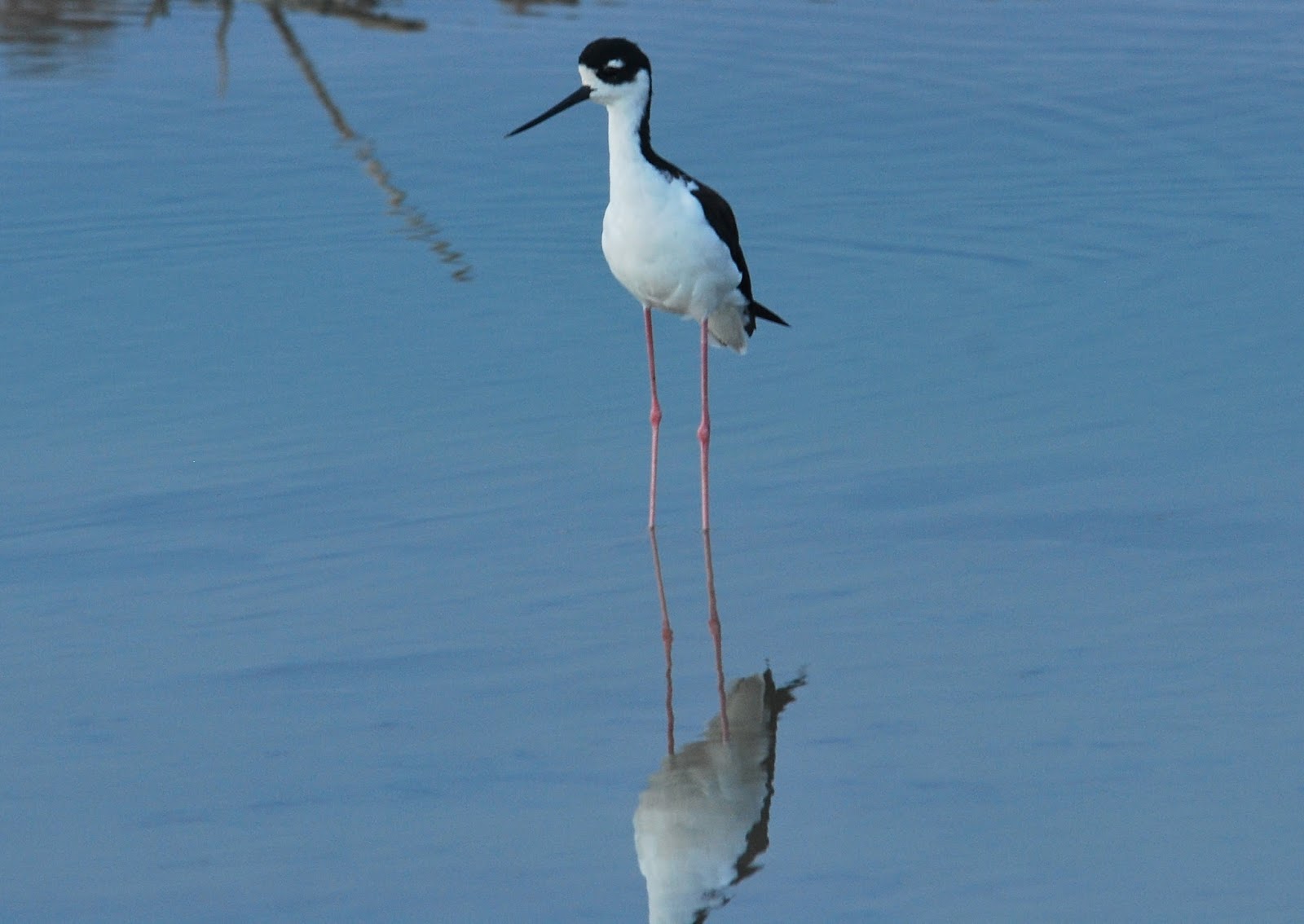
I only saw two Solitary Sandpipers and a Black-necked Stilt among the Cattle, Great and Snowy Egrets, the Southern Lapwings and the lonely White Ibis... but I'm sure this place deserve more visits.

Huge numbers in Aguadulce!

As you may know by now, the Aguadulce Salinas (saltponds) are just 30 minutes away of our house in Penonomé (central Panamá).  I took advantage of this proximity and visited the saltponds very early last sunday hoping to find interesting species closer to the road due to the low traffic at that time... and it worked.
As you can see, the diversity and numbers were awesome... and this is only a fraction of the flock!  Can you see how many species were together in that pond?  The Roseate Spoonbill was, by far, the most attractive bird... the pink shade comes from the food it eats: tiny crustaceans rich in carotenoids produced by the algae they eat as well.  The Wood Stork is not exactly a beauty...but is extremely elegant when flying.  I saw no less than 500 storks along the ponds... and amazing number at any season.
Most egrets and herons were fairly numerous as well, but not as the storks.  The most common was the Great Egret as you can see in the first photo.  Also recorded were Snowy and Cattle Egrets, Great Blue, Little Blue, Tricolored and Green Herons.  The Black-necked Stilts were abundant too... but they like to congregate in little, sparse groups all over the ponds.  They are resident there (the only known breeding site in Panama), but the numbers increase with the arrival of northern migrants.
Despite migration has just started, the ponds were covered in migrant shorebirds and plovers.  Thousands of peeps (including Western, Semipalmated and Least Sandpipers), Semipalmated Plovers and both Lesser and Greater Yellowlegs were feeding at the ponds.  This Greater Yellowlegs shows the typical bicolored (paler to the base), slightly upturned bill, separating it of the Lesser Yellowlegs.
However, it was another migrant that surprised me.  I found a resting group of Black Skimmers in a sand bar in the middle of a pond... not an unusual sight for the site, nor for the time of the year.  Then, more and more flocks started to arrive directly from the sea... I counted 238 birds (at least)... all seemed to belong to the race breeding in North America.
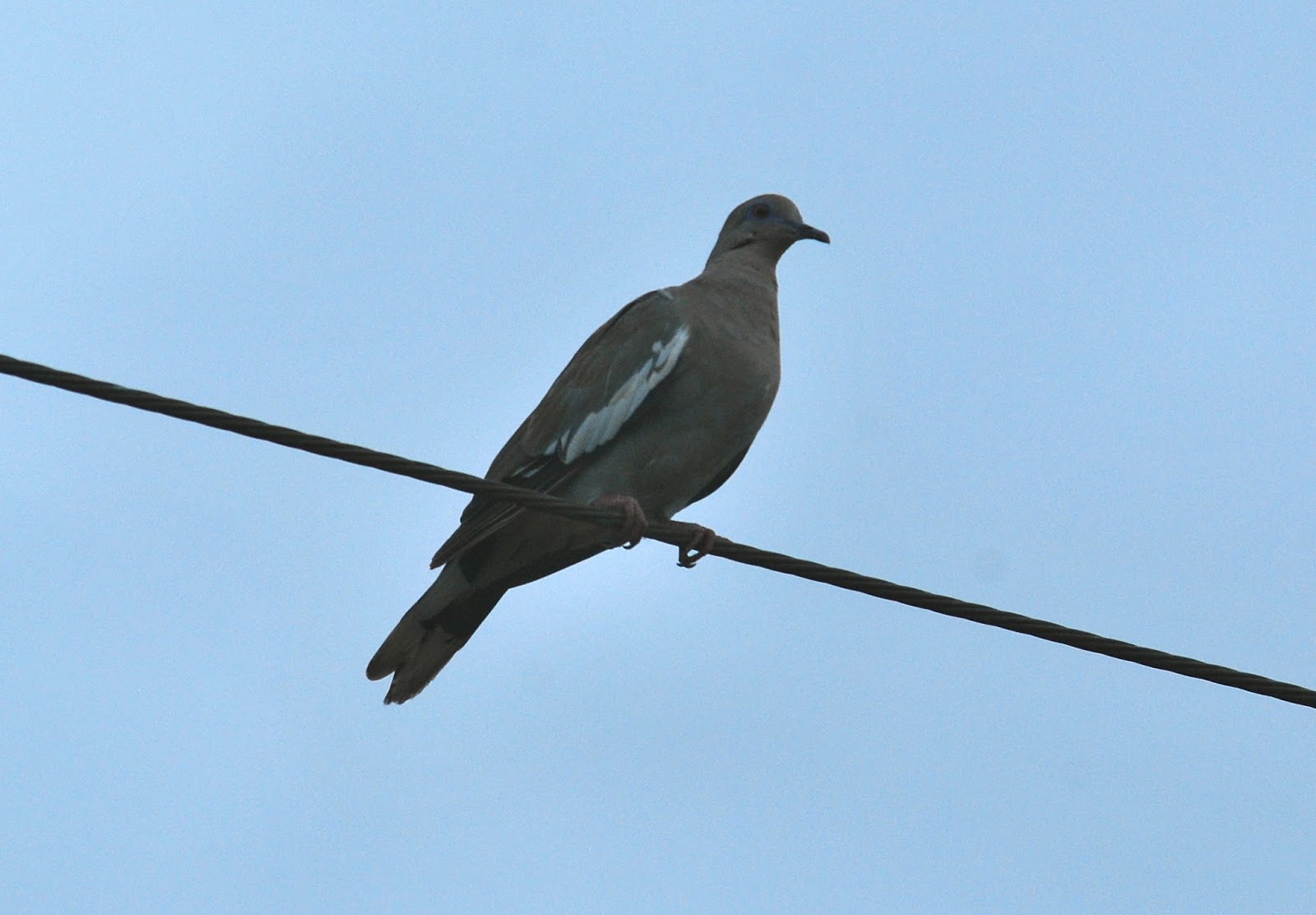
Some other species were simply more conspicuous than in other visits... that was the case of the White-winged Doves.  Restricted to the drier areas along the Parita Peninsula of central Panamá, this species is readily found along the street running parallel to the beach heading to the fishing town of El Salado.  I found many individuals, some in groups of three to four birds, some vocalizing.
The last bird I found in the ponds was also the less expected.  A basic-plumaged Red-necked Phalarope was swimming and feeding, bobbing its head nervously and allowing some shots.  This species is mainly pelagic... that is, usually found away of the coast in the sea; but Aguadulce is a quite regular site to see this migrant.  Well, what a great day at the saltponds!
P.D.:  I count eight (8) different species in the first photo.  How many do you?

In search of THE heron. Part I

There were some clues in the air... something really important was happening to the east of Panamá City.  But in spite of all my suppositions, I never thought that it would be a NEW species for the country and North America!  The news were published in various social media and in Xenornis a week ago.  A Whistling Heron was photographed and videotaped in the outskirts of the town of Chepo, 30 minutes east of Panamá City by Kevin Easley and others.  This is an extraordinaire record, since there are no known populations of this beautiful heron close to the Panamá border in Colombia.  Two distinct populations exists, one in the llanos of Venezuela and eastern Colombia (where I took the next photo, that I published elsewhere); the other, in the open lands of Bolivia to northeastern Brazil and Argentina.
So far, some resident birders visited the place after the first report, but the heron could not have been relocated.  So, accompanied by Rafael Luck, Venicio "Beny" Wilson and Itzel Wong, I went last saturday in search of it.   After checking maps of the area, Beny chose the route, following the old road to Chepo from the town of Palo Blanco, crossing pastures and degraded habitat, but also many gallery forests along creeks and rivers supporting species typical of wetter habitats.  That is so, that in our first stop we found a Rufous-breasted Hermit... essentially unexpected for us.
Others unexpected finds were Brown-hooded Parrots, Gray-headed Kite and this Gray-lined Hawk, nicely perched atop a dead tree.
However, the most common birds were those typical of open lands and marshy areas.  In fact, we checked many marshes in the middle of huge pasture lands, and we were glad to see again some species restricted to this type of habitat.  For example, this Pale-breasted Spinetail was very cooperative, calling from exposed perches and even showing the reason of its name.
And who can't be glad of finding Pied Water-Tyrants?  This elegant bird is restricted to the eastern part of the country, and always is a great bird to see.
And what about the heron?  Well, eventually we found the very same perch where the Whistling Heron was photographed.  The tree was a preferred perch for many species in the surroundings, including  Black-bellied Whistling-Ducks, Little Blue Heron and Great Egrets.  We waited and searched all around, but the heron was not there.
To be honest, we were quite optimistic, considering that the area is huge, full of adequate habitat... it was like looking for a needle in a haystack.  However, we kept searching... only stopping for a quick meal in town.  That habitat was also excellent for birds of prey.  Besides those already mentioned, we saw other seven hawks and kites species, including this majestic Savanna Hawk.
We also saw (or heard) four falconids, including three pairs of American Kestrels.  Formerly only a winter visitor from northern latitudes; now, South American subspecies have been established in our fields.
Notice the completely lack of spots in the underparts of this beautiful male, characteristic of southern subspecies.  Well, we didn't find the heron... but have a lot of fun looking for it!