Showing posts with label American Kestrel. Show all posts

Still looking for THE heron

It seems that the only thing we did last month was to look for the vagrant Whistling Heron reported elsewhere by Kevin Easley et al.  And last weekend was not the exception!  However, this time accompanied by Rafael Luck, Osvaldo Quintero and his son-in-law Joaquín, we stopped first at some marshes just east of Panamá City, the former Tocumen marshes.  Like other days, we found the typical avifauna of these habitats, but dip on the heron again.  Well, nothing to sorry about because we knew it was very unlikely to find the bird so far away of the original spot, but we did have a nice day photographing all sort of birds species, including HUGE numbers of Wood Storks, Neotropic Cormorants all over the place (see the photo above), and many Cocoi Herons, like the one pictured below.
These marshes are also very good for raptors, and we saw or heard Roadside, Common Black and Gay-lined Hawks, plus Pearl and White-tailed Kites too.  This one was perched close to the road allowing some photos.
The site is the only reliable one for Yellow-headed Vulture close to the city, and we found at least three individuals resting close to the road.
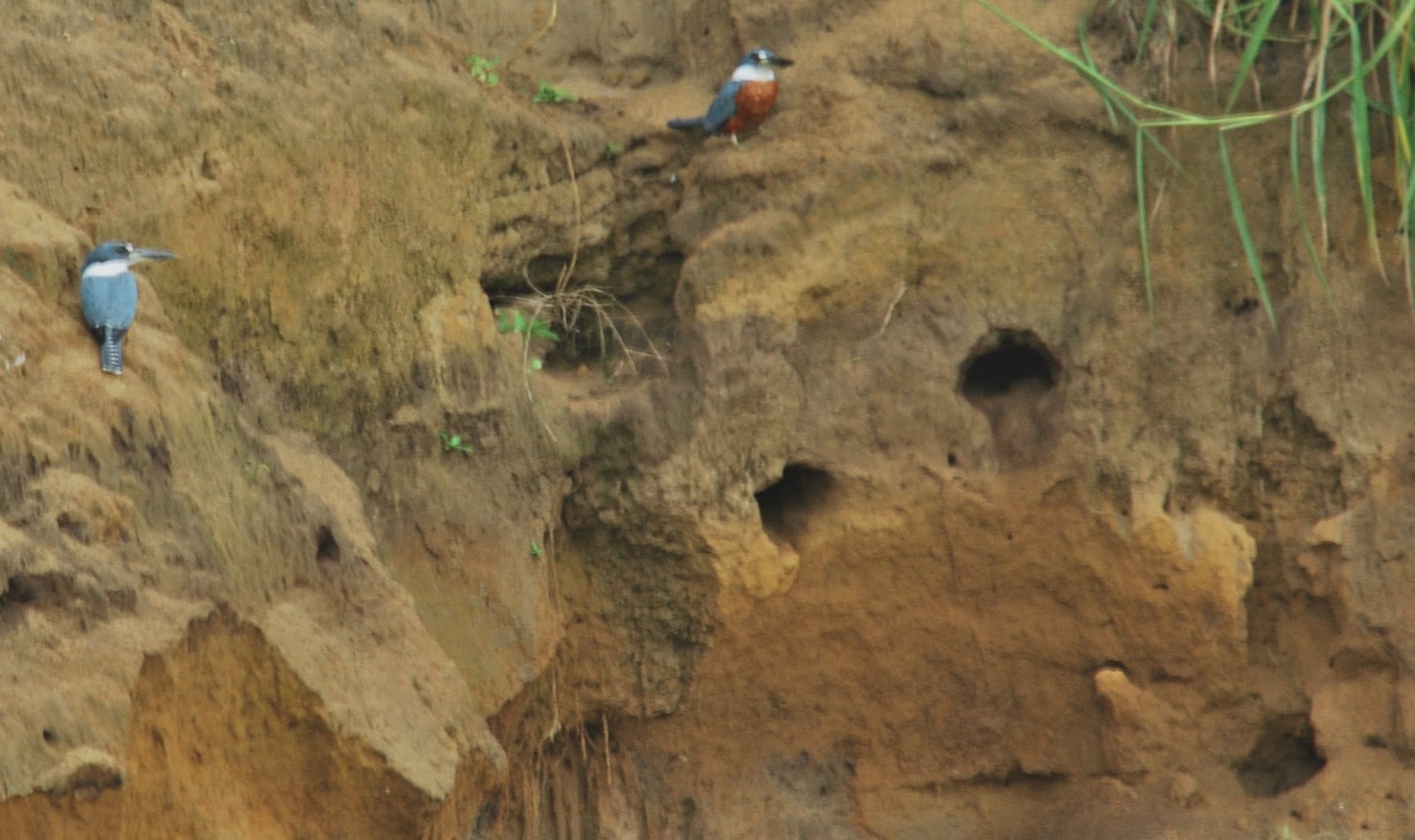
We found no less than six Ringed Kingfishers in one stretch of a creek... soon we realized that they were nesting in the sandy banks.  This image remind me the photos of bee-eaters at their colonies... after all they are related.
We went to the spot near Chepo, but the day was hot and we only found more birders trying, unsuccessfully, to relocate the heron... so we called it a day.  The next day, I joined Karl and Rosabel Kaufmann and, very early, went to the spot near Chepo.  Though we had a good day, we were not able to relocate the Whistling Heron.  We checked miles of dirty roads, finding more Wood Storks and a beautiful Capped Heron sharing the pond with one of the storks.
Again, we saw many raptors, like Roadside and Great Black Hawk, White-tailed Kites, and several pairs of American Kestrels.  Again, notice the absence of spots in the underparts... probably the same individual we photographed some weeks ago in the same spot.
New for our list of the site was this Bat Falcon perched in some wires.  It allowed us to approach closely, a very cooperative bird.
Well, I don't know if the Whistling Heron will be found again... but that area surely will reveal many surprises in the future!
In search of THE heron. Part I

There were some clues in the air... something really important was happening to the east of Panamá City.  But in spite of all my suppositions, I never thought that it would be a NEW species for the country and North America!  The news were published in various social media and in Xenornis a week ago.  A Whistling Heron was photographed and videotaped in the outskirts of the town of Chepo, 30 minutes east of Panamá City by Kevin Easley and others.  This is an extraordinaire record, since there are no known populations of this beautiful heron close to the Panamá border in Colombia.  Two distinct populations exists, one in the llanos of Venezuela and eastern Colombia (where I took the next photo, that I published elsewhere); the other, in the open lands of Bolivia to northeastern Brazil and Argentina.
So far, some resident birders visited the place after the first report, but the heron could not have been relocated.  So, accompanied by Rafael Luck, Venicio "Beny" Wilson and Itzel Wong, I went last saturday in search of it.   After checking maps of the area, Beny chose the route, following the old road to Chepo from the town of Palo Blanco, crossing pastures and degraded habitat, but also many gallery forests along creeks and rivers supporting species typical of wetter habitats.  That is so, that in our first stop we found a Rufous-breasted Hermit... essentially unexpected for us.
Others unexpected finds were Brown-hooded Parrots, Gray-headed Kite and this Gray-lined Hawk, nicely perched atop a dead tree.
However, the most common birds were those typical of open lands and marshy areas.  In fact, we checked many marshes in the middle of huge pasture lands, and we were glad to see again some species restricted to this type of habitat.  For example, this Pale-breasted Spinetail was very cooperative, calling from exposed perches and even showing the reason of its name.
And who can't be glad of finding Pied Water-Tyrants?  This elegant bird is restricted to the eastern part of the country, and always is a great bird to see.
And what about the heron?  Well, eventually we found the very same perch where the Whistling Heron was photographed.  The tree was a preferred perch for many species in the surroundings, including  Black-bellied Whistling-Ducks, Little Blue Heron and Great Egrets.  We waited and searched all around, but the heron was not there.
To be honest, we were quite optimistic, considering that the area is huge, full of adequate habitat... it was like looking for a needle in a haystack.  However, we kept searching... only stopping for a quick meal in town.  That habitat was also excellent for birds of prey.  Besides those already mentioned, we saw other seven hawks and kites species, including this majestic Savanna Hawk.
We also saw (or heard) four falconids, including three pairs of American Kestrels.  Formerly only a winter visitor from northern latitudes; now, South American subspecies have been established in our fields.
Notice the completely lack of spots in the underparts of this beautiful male, characteristic of southern subspecies.  Well, we didn't find the heron... but have a lot of fun looking for it!