Showing posts with label Pampa de Achala. Show all posts

One day, MANY endemics!

Did I mention that Jorge and I saw some national endemics while birding the Sierras Grandes west of Córdoba (central Argentina)?  In my previous post, I pictured the Carbonated Sierra-Finch which is an Argentina endemic with a quite large distribution within the country.  Beside the sierra-finch, we found other three (3!) national endemics that day in Pampa de Achala.  The first one was a species that, like the sierra-finch, also has a large distribution within the boundaries of Argentina: the Cinnamon Warbling-Finch.
We saw a male mixed with Rufous-collared Sparrows as you can see in the photo.  There are some autumn and winter reports from Uruguay, but that seems to be a rare vagrancy pattern.  In contrast, the next species (and subspecies) are completely restricted to these plateau.  Jorge took me to the banks of the Yuspe river and waited.  Soon, one of our first targets showed up as expected by Jorge:
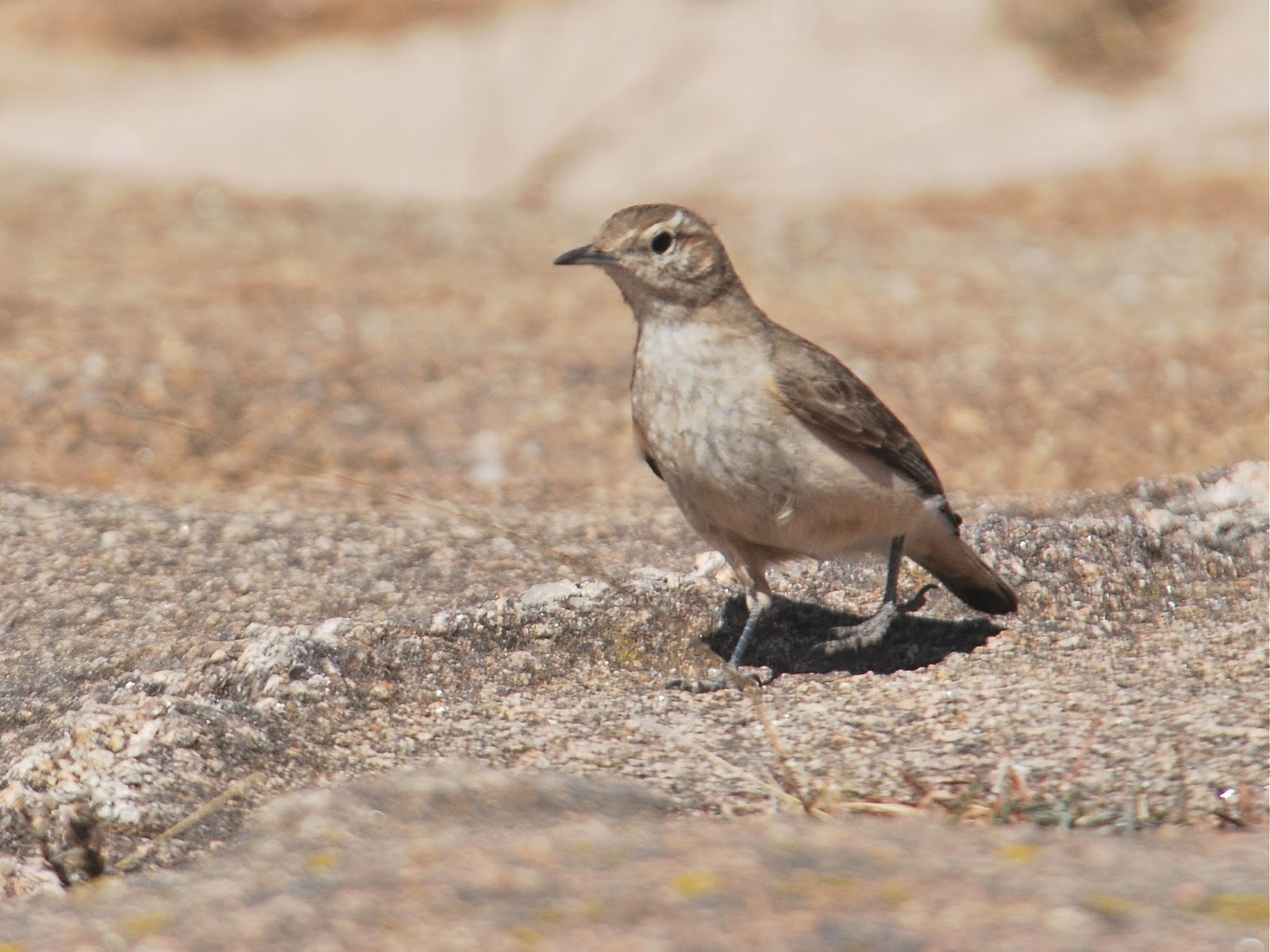
Previously considered a subspecies of more widely distributed species, the Olrog's Cinclodes is essentially restricted to Pampa de Achala.  Notice the conspicuous white in the closed wing, the bicolored eyebrow and the short, thin bill.
We walked a little bit, finding another Olrog's Cinclodes, this time accompanied by a Common Miner... also an endemic subspecies (contrerasi) for these sierras.  The spanish name of "caminera" refers to the habit of walking that these birds exhibit.
After a while, we found other furnariid sharing the same riverine habitat: a White-winged Cinclodes.  Compared to Olrog's Cinclodes, notice the obvious longer bill, the striking white bar in the closed wings, and the darker look overall.  This is also an endemic subspecies, schocolatinus, looking quite different to the geographically distant nominate.
With our targets in the bag, we moved to the highest part of the road the we reached that day, the Cuchilla Nevada, well over the 1800 meters above sea level.  No water up there, only arid grassy and shrubby pampa with rocky stands.  Now, we were after other endemic, the third cinclodes species for the day.  We did several stops in apparently suitable sites... then, the bird materialized in front of us.
That's right: Cordoba Cinclodes!  Just with the name you can assume that this is a range-restricted endemic (even with its Latin name: Cinclodes comechingonus).  Notice the rufous wing band.  My  next photo shows the yellow base to the lower mandible... but that was not very evident in the field.
By that time, I was more than happy... but Jorge had another surprise for me.  We stopped at a different type of habitat... this time less rocky and more shrubby.  Some playback and then a Puna Canastero hopped into evidence atop a shrub.  This species was first described from these sierras, and some think that the other subspecies described later don't belong to this species... some even call this bird "Cordoba" Canastero.
That was really a great day... full of endemics and distinct forms.  As bonus, we visited the shores of the San Roque lake, in the Punilla valley, finding the forth species of cinclodes for the day: two Buff-winged Cinclodes.
Formerly part of the Bar-winged Cinclodes complex, this partially migratory species is restricted to the south cone of the continent... so it was a lifer for me!  Four Cinclodes in one day, all of them lifers for me... amazing!  But the lifers festival don't stop here... stay tuned for more!

Birding Córdoba's Sierras Grandes.

As I mentioned elsewhere, I visited Córdoba (central Argentina) attending an academic event some days ago.  After the event, I had some spare time for birdwatching.  Previous to my trip, I tried to contact a birding pal or professional tour guide to maximize my time finding the key species of the region... the first one to answer my beg was Jorge Martín Spinuzza (of avespampa.com.ar).  Kindly, Jorge offered to take me along several different habitats in order to find as many species as possible in the limited amount of time available.  His plan was to visit Córdoba's Sierras Grandes, a mountain range running from north to south, older than the high Andes and with a distinct avifauna.  The road to the higher parts crossed several different habitats, giving me the chance to see many species.  I'll focus  on those species seen in the higher parts of the sierras, those seen at the extensive foothills (piedemonte) and in the high plateau known as the Pampa de Achala, above 1800 meters above sea level (masl).  From there, several peaks elevate reaching over 2200 masl, including Los Gigantes (2350 masl), pictured in the background of the first photo.
The foothills were impressive... hundreds of kilometers of unobstructed view of the horizon, covered in grass, shrubs and some scattered trees, most of them introduced, around the houses and the estancias.  It was pretty good for raptors, like American Kestrel, Chimango Caracara and Southern Caracaras.  The above individual seemed to be nesting in those trees.  Compared to our Crested Caracaras, these birds looked larger, with more evident barring in the underparts and back.  We also saw a Variable Hawk perched on a rock fence... what a bird!
Certainly, this species have the most variable plumage of all the hawks... this is, evidently, of the "red-backed" form, perhaps a female due to its hugeness.  With all those raptors around, it is no surprise why this Spotted Nothura was crossing the road at full speed.
In contrast to our tinamues, this species was quite easy to spot... at least for some seconds before disappearing into the grass.  In fact, due to the habitat, most of the birds were quite easy to see.  In a quick succession we saw Southern Lapwings, Hellmayr's Pipit, Grassland Yellow-Finches, Chalk-browed Mockingbird, among others.  However, the most striking so far were the Long-tailed Meadowlarks.
This species, locally known as Loica, is represented up there by the endemic subspecies obscura... the first of many endemic forms we were about to see restricted to this mountain range.  In general, the birds of the higher parts (Pampa de Achala) recall those found in the high Andes.  For example, you  know you're not anymore in Panamá when a young Andean Condor soars above you!
Or this Black-billed Shrike-Tyrant that allowed great photos in the highest part of the road (Cuchilla Nevada)... compare both species with my previous photos from Ecuador.
But there are BIG differences with the Andes.  The isolation of this range is the reason why there are so many distinct forms and even endemic species (more about them in my next post).  Take for example the sierra-finches (yes, if you are birding the sierra you expect sierra-finches).  The most common, sometimes in flocks of 15 - 20 birds, were the Ash-breasted Sierra-Finches.  Not an endemic species (I had seen this -and the next species- in the Andes of Perú and Ecuador), but represented there by the endemic subspecies .  The same for the Plumbeous Sierra-Finch, represented in these sierras by the endemic subspecies cyaneus (compare with my previous photo from Ecuador).
I posted the photos of these two species next to each other so you can notice the faint facial marks and blurry streaks on the back of the Ash-breasted Sierra-Finch, and the more uniform bluish-gray color of the Plumbeous Sierra-Finch... field marks to ID correctly these guys.  But we saw another species of sierra-finch... not in the highest parts, but in the foothills.  Jorge was excited about the finch we were photographing.  Notice the lack of rufous or chestnut in the ear covers of the female and the extensive black underparts of the young male.
Carbonated Sierra-Finches!  This species is endemic of Argentina, and not that common for that place.  The field marks pointed above separate this species from the similar Mourning Sierra-Finch (that I saw in Perú many years ago).  The curious thing is that I just realized this bird is a national endemic... in the field it was just another lifer!  The Carbonated Sierra-Finch was the last endemic I saw that day... if you want to know the endemics we got earlier, don't miss my next post.